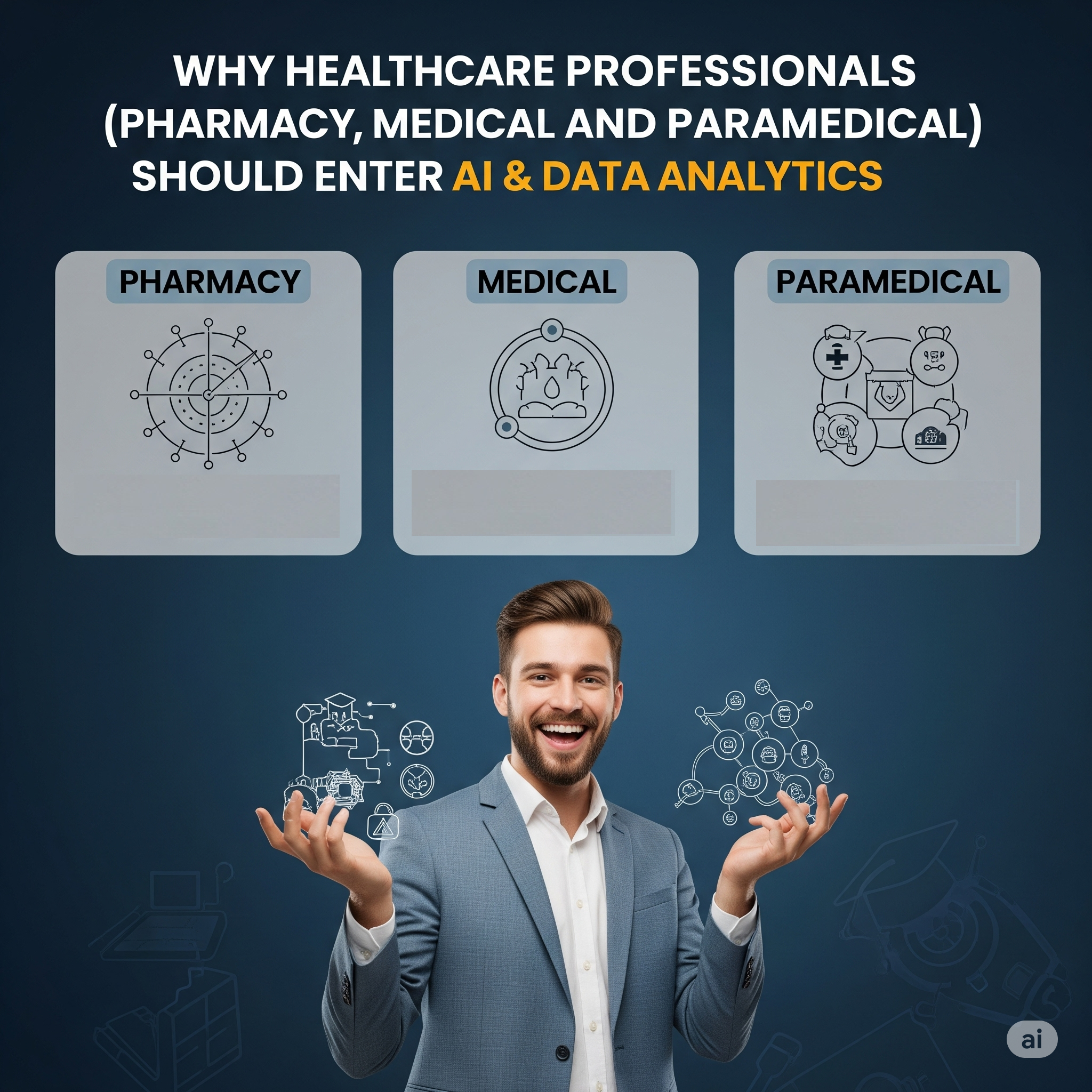
Why Healthcare Professionals (Pharmacy, Medical and Paramedical) Should Enter AI & Data Analytics
A career in AI & Data Analytics for healthcare professionals is one of the most promising and rapidly expanding fields globally. With the increasing digitization of healthcare and the explosion of health-related data (from EHRs, diagnostics, wearables, genomics, etc.), AI and analytics skills are now highly valued even among non-technical healthcare workers.
🔍 Why Healthcare Professionals Should Enter AI & Data Analytics
| Reason | Details |
|---|---|
| Huge Data Availability | Electronic health records (EHRs), medical imaging, genomics, wearable devices provide rich datasets. |
| Improved Patient Care | AI helps in early diagnosis, personalized treatment, and reducing medical errors. |
| Bridging Clinical and Technical Gaps | Professionals with both domain (medical) and data (AI) knowledge are in high demand. |
| Research and Innovation | Opportunities to work in cutting-edge areas like precision medicine, predictive modeling, digital health. |
📌 Core Areas of Application
| Domain | AI/Data Analytics Application |
|---|---|
| Medical Imaging | AI for tumor detection, CT/MRI image analysis |
| Predictive Analytics | Forecasting disease outbreaks, ICU readmissions |
| Genomics | AI for gene-disease correlation, mutation analysis |
| Hospital Management | Optimizing staffing, patient flow, resource utilization |
| Drug Discovery | AI models for drug-target prediction, repurposing |
| Personalized Medicine | Using patient data to tailor treatments |
| Pharmacovigilance | Signal detection for adverse drug reactions |
| Remote Monitoring | Analyzing wearable data for chronic disease management |
📚 Skills You Need to Learn
Even as a healthcare professional, you don’t need to become a full data scientist to enter the field. However, the following skillsets are important:
✅ Must-Have Knowledge
-
Statistics & Biostatistics
-
Basic Python or R
-
Medical Terminology & Clinical Data Interpretation
-
Basics of Machine Learning & AI
✅ Tools & Technologies
| Type | Tools |
|---|---|
| Data Analysis | Excel, R, Python (Pandas, NumPy) |
| Visualization | Tableau, Power BI, Matplotlib, Seaborn |
| ML/AI Libraries | Scikit-learn, TensorFlow, Keras |
| Healthcare Data Standards | HL7, FHIR, SNOMED CT, ICD-10 |
🎓 Educational Pathways
| Type | Examples |
|---|---|
| Short-Term Courses | Coursera, edX, Udemy (AI in Healthcare, Data Science for Health) |
| Diploma/PG Certifications | PG Diploma in Health Informatics, AI for Healthcare |
| Master’s Programs | MS in Biomedical Informatics, Health Data Science |
| Fellowships | AI in Medicine Fellowships (AIIMS, Stanford, etc.) |
💼 Career Roles (with Medical + AI Background)
| Role | Description |
|---|---|
| Clinical Data Analyst | Analyzes patient data for hospitals or research |
| Medical AI Specialist | Works on AI/ML models for diagnostics or prediction |
| Health Informatics Officer | Bridges IT systems and clinical workflows |
| Digital Health Researcher | Explores AI-based interventions in clinical settings |
| Regulatory Data Scientist | Works with pharmacovigilance and regulatory analytics |
| Clinical Trial Data Manager | Oversees data for AI-assisted clinical studies |
💰 Salary Potential (India & Abroad)
| Role | India (INR/year) | USA/UK (USD/year) |
|---|---|---|
| Clinical Data Analyst | ₹5 – 12 LPA | $70,000 – $100,000 |
| Health Data Scientist | ₹10 – 25 LPA | $100,000+ |
| Medical Informatics Expert | ₹8 – 20 LPA | $90,000 – $120,000 |
📈 Future Scope
-
Integration of AI in telemedicine and mobile health
-
Expansion in precision and personalized medicine
-
More government & private investments in digital health
-
AI integration in public health and epidemic management
✅ How to Start (Action Steps)
-
Identify Your Interest (Imaging? Genomics? Hospital Analytics?)
-
Learn Python & Statistics
-
Take Healthcare-Focused AI Courses (e.g., “AI for Medicine” by deeplearning.ai)
-
Work on Real-World Datasets (OpenEHR, MIMIC-III, PhysioNet)
-
Join Projects, Internships, or Research Groups
-
Start Publishing or Contributing to Health AI Studies