Pharmacovigilance Jobs 2026–2036: High Salary, High Demand & Future-Proof Career Path
Career in Pharmacovigilance for the Next 10 Years: A High-Demand Path Protecting Patient Safety
Pharmacovigilance (PV)—the science and activities related to detecting, assessing, understanding, and preventing adverse effects of medicines—has evolved from a compliance-focused function into a strategic pillar of the pharmaceutical industry. As drug pipelines expand with biologics, cell and gene therapies, and complex combinations, and as regulators demand more proactive safety monitoring, careers in this field look exceptionally strong through 2035 and beyond.
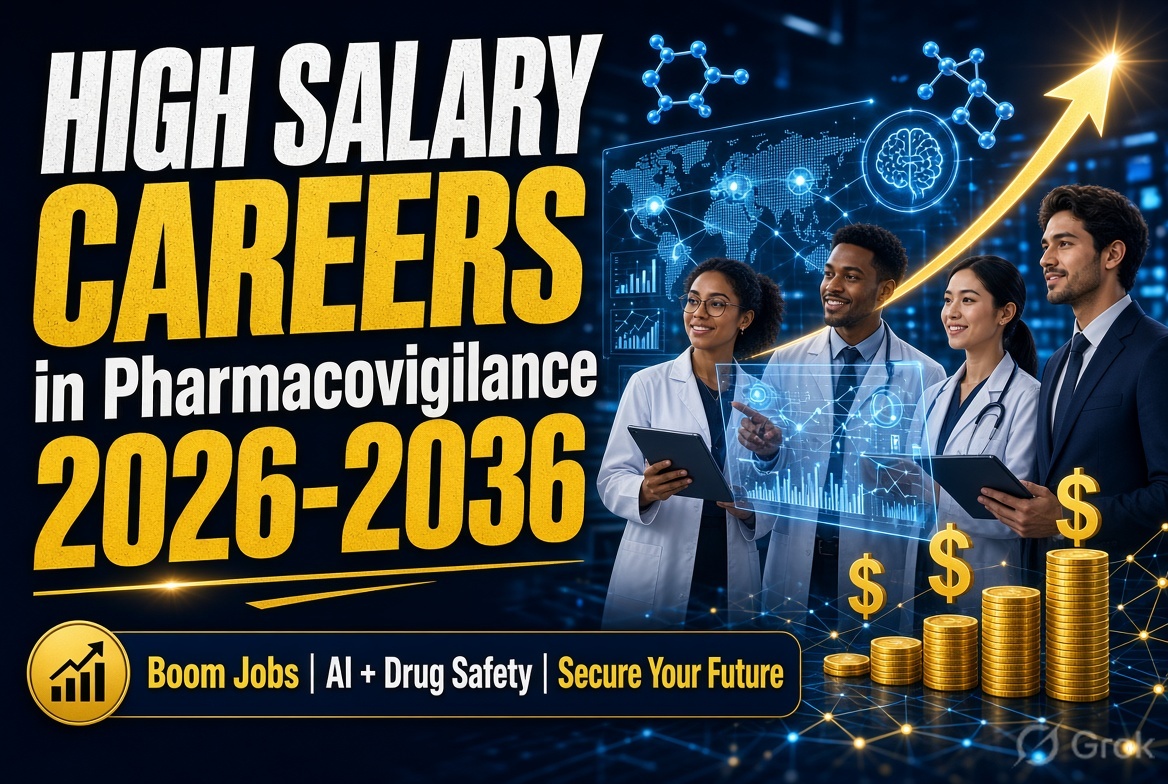
Market Growth and Job Outlook
The global pharmacovigilance market is expanding rapidly. Estimates place its current size in the $8–10 billion range, with forecasts projecting growth to $18–26 billion (or higher in some analyses) by the early-to-mid 2030s, at compound annual growth rates typically between 8% and 12%. Drivers include rising drug consumption, more adverse event reports, outsourcing to specialized CROs and BPOs, and the integration of AI-powered tools.
This growth translates into steady job demand. The industry already needs tens of thousands of professionals globally and faces projected shortages (some analyses cite a potential 35% shortfall of qualified talent by 2030). New drug approvals, stricter post-marketing requirements, and the sheer volume of safety data create ongoing need. Job growth is expected in the mid-single digits annually overall, with faster expansion in analytics, signal detection, risk management, and technology-related roles. Demand remains resilient even during broader biopharma slowdowns because safety obligations do not pause.
Key hiring locations include North America (especially the US), Europe (UK, Germany, Switzerland, Netherlands—strong for QPPV and regulatory roles), and Asia-Pacific (India remains a major outsourcing hub; Japan, Singapore, and others are growing). Opportunities exist at pharmaceutical and biotech sponsors, contract research organizations (CROs), technology vendors building safety platforms, and regulatory agencies.
Key Trends Shaping the Next Decade
Several forces will redefine PV work between now and the mid-2030s:
- AI and automation — Routine case processing, literature screening, coding (e.g., MedDRA), and initial triage are increasingly handled by AI, natural language processing, and machine learning. This can reduce manual effort dramatically (in some scenarios by 90% for certain tasks). Humans shift toward validating AI outputs, handling complex or serious cases, clinical judgment, and governance of explainable AI systems. Roles bridging PV knowledge with AI tool configuration, validation, and compliance will be in high demand.
- Shift from reactive to proactive and real-time safety — Regulators (FDA, EMA, and others) are pushing toward continuous monitoring, real-world evidence (RWE) from electronic health records, wearables, and digital sources, and earlier signal detection. Translational safety—linking preclinical, clinical, and post-market data—will grow in importance.
- Complex therapies — Biologics, advanced therapy medicinal products (ATMPs such as cell and gene therapies), oncology drugs, and combination products require specialized, long-term safety follow-up and more sophisticated risk management plans. Expertise in these areas commands premiums.
- Regulatory evolution and global harmonization pressures — Updates to Good Pharmacovigilance Practices (GVP), E2B standards, signal management modules, and frameworks around AI in healthcare (e.g., EU AI Act considerations) keep compliance workloads high. Audits and inspections remain frequent.
- Data explosion and outsourcing dynamics — Case files are larger and more multimodal. Sponsors often retain strategic work (signal evaluation, benefit-risk assessment, labeling) while outsourcing high-volume processing. This creates dual career tracks: operational/delivery expertise and higher-value scientific/strategic roles.
Career Paths and Progression
Typical progression offers clear ladders with specialization options:
- Entry-level (0–2/3 years): Drug Safety Associate / PV Associate / Case Processor / ICSR Processor. Focus on adverse event intake, coding, database entry (Argus, ArisGlobal, Veeva Vault Safety, etc.), and basic compliance.
- Mid-level (3–7 years): Senior Associate, Aggregate Report Writer (PSURs, DSURs, PADERs), Safety Data Analyst, Signal Detection Specialist, or Team Lead. Involvement in literature review, risk management, and medical assessment grows.
- Advanced / Leadership (7–10+ years): PV Manager / Global PV Lead, Drug Safety Scientist, Benefit-Risk Lead, Risk Management Lead, Director of Pharmacovigilance / Safety Operations, or QPPV (Qualified Person for Pharmacovigilance—high-accountability EU role). Some move into medical safety (physicians preferred), PV quality/inspection readiness, or informatics/systems ownership.
Alternative or adjacent paths include transitions into regulatory affairs, clinical research, medical writing, epidemiology/pharmacoepidemiology, or PV technology/AI governance roles. Physicians and those with strong clinical backgrounds often advance faster into medical review and strategic positions.
Essential Skills for the Future
Core foundations remain: life sciences, pharmacy, nursing, medicine, or related degrees; solid understanding of pharmacology, physiology, and adverse event assessment; and knowledge of global regulations (ICH guidelines, GVP modules, FDA/EMA/local requirements).
Future-proof skills include:
- AI literacy and ability to critically evaluate/validate automated outputs.
- Data analytics, basic statistics, and comfort with large datasets or RWE.
- Proficiency with major safety databases and tools.
- Strong clinical judgment, critical thinking, and medical writing.
- Communication, cross-functional collaboration, and attention to detail.
- Specialization in high-growth areas (oncology, ATMPs, signal management, or RWE).
Certifications, continuous professional development (e.g., through DIA or similar), and hands-on database experience accelerate entry and advancement. Soft skills—curiosity, coachability, and a patient-safety mindset—become even more differentiating as technology handles routine work.
To strengthen your foundation and improve employability in this competitive field, pursuing a Post Graduate Diploma in Pharmacovigilance is a smart and highly recommended step. These specialized programs provide in-depth knowledge of drug safety regulations, adverse event reporting, signal detection, risk management, and global guidelines such as ICH and GVP. Many courses also include practical training on industry-standard safety databases and real-world case studies, giving freshers and career switchers a significant edge during recruitment. Completing a recognized PG Diploma not only enhances your technical expertise but also signals to employers that you are serious about building a long-term career in pharmacovigilance.
Compensation Snapshot (US, UK, India)
Salaries vary significantly by location, company type (sponsor vs. CRO), experience, and specialization:
- Entry-level: Roughly $60k–$90k USD in the US; lower in India (₹3–5+ LPA) and varying elsewhere.
- Mid-level: Often $80k–$130k+ USD (or equivalent regional ranges).
- Senior/leadership: $120k–$180k+ USD, with directors and QPPVs higher, plus bonuses. Specialized expertise (biologics, AI-related, certain therapeutic areas) can add 15–25% premiums.
India and other outsourcing hubs offer strong volume of roles with global exposure, while mature markets (US, Western Europe) generally provide higher absolute compensation and more strategic work.
Challenges and Opportunities Ahead
Challenges include talent shortages at mid-to-senior levels, the need to continuously upskill alongside AI, data privacy/cybersecurity considerations, and the complexity of new therapies. Some entry-level operational roles may see pressure from automation, making specialization important.
Opportunities far outweigh these: meaningful work that directly protects patients, job stability rooted in regulatory necessity, clear progression paths, remote/hybrid flexibility in many cases, and the chance to work at the intersection of medicine, data science, and regulation. Professionals who combine scientific rigor with technological fluency and strategic thinking will be especially well-positioned.
Why Choose Pharmacovigilance Now?
For the next 10 years, pharmacovigilance offers a resilient, growing career with purpose. Every new medicine approved expands the need for safety oversight. As the field becomes more data-driven, proactive, and technology-enabled, it rewards those who invest in continuous learning. Whether you enter from pharmacy, life sciences, medicine, nursing, or a data background, the combination of steady demand, impactful work, and evolving high-value roles makes PV one of the stronger long-term options in the life sciences sector.
If you’re considering a move into the field, focus on building foundational regulatory and database knowledge now, seek exposure to signal detection or aggregate reporting early, and cultivate AI literacy. The patients who benefit from safer medicines—and the industry that develops them—will need skilled professionals like you.