How to Get Trained in Pharmacovigilance Software: A Complete Guide for Pharmacy Students in 2026
What Is Pharmacovigilance Software?
Pharmacovigilance software consists of specialized systems used by pharmaceutical companies, CROs and regulatory organizations to collect, process, evaluate, track and report drug-safety information.
These systems can be used for activities such as:
- Adverse event case processing
- Individual Case Safety Reports (ICSRs)
- Serious adverse event management
- Medical review
- Signal detection
- Aggregate reporting
- Drug safety database management
- Regulatory submissions
- Safety data analysis
- Quality control and workflow management
Instead of maintaining thousands or millions of safety reports manually, pharmaceutical companies use specialized safety databases to manage these activities.
Which Pharmacovigilance Software Should You Learn?
There is no single PV software that every company uses. Different pharmaceutical companies and CROs may use different platforms.
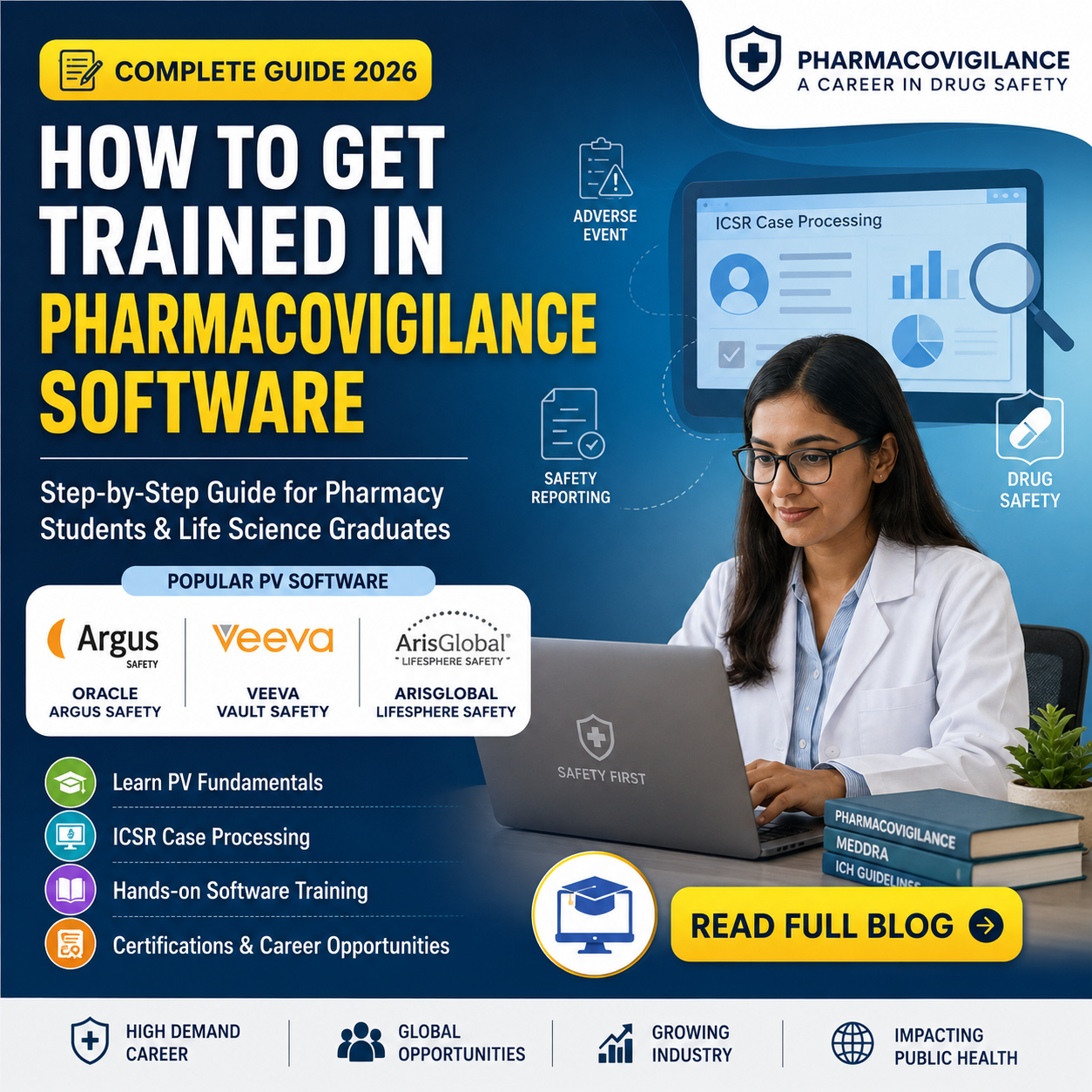
Some important systems and technology platforms associated with pharmacovigilance include:
1. Oracle Argus Safety
Oracle Argus Safety is one of the best-known safety case management systems used in the pharmaceutical industry.
Students interested in drug safety case processing may encounter Argus in job descriptions for pharmacovigilance roles.
Typical activities supported by safety systems such as Argus include:
- Case creation
- Data entry
- Case assessment
- Coding
- Seriousness assessment
- Expectedness assessment
- Narrative preparation
- Workflow management
- Quality control
- Regulatory reporting
2. Veeva Vault Safety
Veeva Vault Safety is another major cloud-based safety platform used for pharmacovigilance and safety operations.
It is increasingly relevant because many organizations are adopting cloud-based systems.
3. ArisGlobal LifeSphere Safety
ArisGlobal’s LifeSphere Safety platform is another important technology platform used for pharmacovigilance and drug safety operations.
It supports activities across safety case processing and broader safety management workflows.
4. Other Safety Technologies
Depending on the company, you may encounter additional platforms for:
- Safety case management
- Signal detection
- Literature monitoring
- Medical information
- Regulatory submissions
- Data analytics
- Clinical safety
Therefore, students should not focus exclusively on memorizing one software name.
The most valuable skill is understanding the pharmacovigilance workflow and then learning how that workflow is performed within a safety database.
Do You Need Software Training to Get a Pharmacovigilance Job?
Not always.
This is an important point for freshers.
Many entry-level pharmacovigilance positions may provide company-specific training after recruitment. Employers may evaluate candidates based on:
- Pharmacovigilance knowledge
- Medical terminology
- Understanding of adverse events
- ICSR concepts
- Clinical knowledge
- Regulatory awareness
- Communication skills
- Attention to detail
- Computer skills
However, having exposure to a safety database can make your CV more relevant.
For example, instead of writing:
“Interested in pharmacovigilance.”
you could demonstrate:
“Completed practical training in ICSR case processing and gained exposure to safety database workflows.”
The second statement provides more evidence of job-oriented preparation.
How Can Students Get Trained in Pharmacovigilance Software?
There are several routes.
Route 1: University or College Training
Some pharmacy colleges and universities organize:
- Pharmacovigilance workshops
- Drug safety certificate programs
- Industry interaction programs
- Hands-on PV training
- Guest lectures by industry professionals
This can be a good starting point because students can learn both theory and practical workflow.
If your college does not offer such training, you can request the department to organize a workshop with a pharmacovigilance professional or training organization.
Route 2: Online Pharmacovigilance Courses
Several educational platforms offer online courses in pharmacovigilance.
When selecting a course, don’t choose one simply because it contains the words “certificate” or “software training.”
Check whether the course actually covers practical activities.
A good beginner-level course should ideally include:
Pharmacovigilance Fundamentals
- Definition and scope of PV
- ADR vs ADE
- Adverse event
- Serious adverse event
- ICSR
- Expectedness
- Causality
- Pharmacovigilance regulations
Case Processing
- Case intake
- Validity criteria
- Duplicate search
- Data entry
- Medical review
- Coding
- Seriousness assessment
- Expectedness assessment
- Narrative writing
- Quality control
Software Workflow
- Case creation
- Patient information
- Reporter information
- Suspect drug
- Concomitant medication
- Adverse event
- Medical history
- Laboratory information
- Case assessment
- Workflow
- Case closure
A course containing these components is generally more useful than a course that only provides theoretical lectures.
Route 3: Learn Through a Software Demonstration
This is particularly useful for students.
You can search for demonstrations and educational material using terms such as:
“Oracle Argus Safety case processing tutorial”
“Pharmacovigilance Argus case processing training”
“Veeva Vault Safety training”
“ICSR case processing practical training”
However, be careful.
You may find videos showing software interfaces, but watching a video is not equivalent to hands-on training.
The ideal learning sequence is:
Concept → Demonstration → Practice Case → Assessment → Documentation
Route 4: Industry Internship
For students who want serious practical exposure, an internship can be one of the best options.
Look for internships in:
- Pharmaceutical companies
- CROs
- Pharmacovigilance service providers
- Clinical research organizations
- Drug safety departments
During an internship, you may learn how real-world PV teams handle:
Case intake → Triage → Data entry → Medical review → Coding → QC → Submission
Actual software access will depend on the organization’s policies and your role.
Can You Learn Oracle Argus for Free?
This is where students need to be careful.
Oracle Argus Safety is commercial enterprise software.
You should not download or use unauthorized/cracked versions of the software.
Instead, look for:
- Authorized training
- Institutional training
- Vendor-provided educational resources
- Demonstrations
- Industry internships
- Training environments provided by legitimate training organizations
The objective should be to understand how a safety database works, rather than obtaining an unauthorized copy of commercial software.
Do You Need to Learn Argus, Veeva and ArisGlobal All Together?
No.
For a fresher, trying to learn multiple enterprise platforms simultaneously can become confusing.
A better strategy is:
Step 1
Learn pharmacovigilance fundamentals.
Step 2
Learn ICSR case processing.
Step 3
Understand the workflow of a safety database.
Step 4
Get exposure to one major PV platform.
Step 5
Learn the terminology used across other systems.
Once you understand one system, learning another becomes easier because many underlying PV processes are similar.